The trip to London concluded to one of my favourite museums, the Victoria and Albert (V&A) museum. Whenever I’m in London, I always try and visit the V&A and I’ve still only seen a small fraction of the incredible collection they have.
Everything about the V&A is fabulous – the building, the exhibitions, the entire scale of the museum. If you can think of it, they probably have a collection on it. I’ve seen everything from a collection of locks and locking mechanisms, to armour for animals alongside more traditional pieces of art.
As it is a British national museum, entrance is absolutely free. You do have to pay to see the special exhibitions (tickets are around £15 for non-members) they have but that is it. They have an extensive gift shop and cafes if you want to support the work they do, which I would wholeheartedly encourage. There are few museums with collections as extensive and varied as the V&A’s.
This weekend was the Quilt UK show at the Three Counties Showground in Malvern. After driving through a showcase of weather from all four seasons to get there, the rain thankfully held off long enough to make a quick dash to the main hall.
I go to shows always hoping to see something a little bit different, some unusual fabrics or find a new supplier that does something amazing. I also love getting the chance to see projects and patterns in the flesh as well; it’s much easier to judge whether I want to make something having seen it and you often see loads of great inspiration from some talented crafters.
However, Quilt UK left me feeling a little disappointed. I wish I had paid the advance ticket price (50 % off) as the full adult price (£9) felt a bit excessive for the size of the show. Maybe I’ve been spoiled by having a good local fabric shop, but I wasn’t that enthused by the majority of what was on offer.
There is one type of fabric though that will never fail to turn my head. Batiks. I love batiks to such an insane degree my ‘stash’ is mostly just piles of batiks I have bought because I’ve been so mesmerised by the colours all common sense about only buying for projects flew out the window.
With my design finished after Day 1 and having done some colouring and planning for homework, it was time to start framing up my Jacobean crewelwork piece.
Framing up on an embroidery frame is often a very different beast to ‘just’ popping a piece in a ring frame. However, it is worth doing as ring frames can’t hold that much tension on the fabric and even if you get it ‘drum tight’ to start, after a few hours of stitching you end up yanking the material back through the ring, desperately trying to stop it being a saggy, sad mess.
With slate frames, there are no such issues. They will happily keep tension for years, ideal if the average duration of your embroidery projects is a decade, and you can get very even, tight tensions making it much easier to be precise with the stitching.
A blank canvas
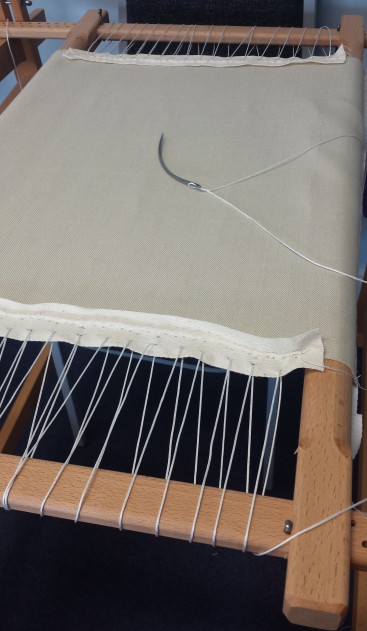
The whole process is quite involved, as you essentially need to add pieces of calico and webbing to your original fabric (linen twill in my case) to allow you to attach it to the frame. This means a lot of hand sewing to attach the additional pieces of fabric and some bloody fingers as well in my case.
The webbing is attached down the sides for lacing into and the calico is attached at the top so you can sew it to the scrap fabric attached to the roller bars on the frame. The roller bars stretch the work vertically and the lacing provides the horizontal stretch. The roller bars so what the name implies, once you’ve stitched the fabric on you roll them around to start applying the tension.
The oversized, vicious looking needle on the middle of the linen there is a bracing needle. There’s a short health and safety talk before you get to use one of these, about keeping the point safely embedded in some cork for storage and making sure to sew down through the fabric so you don’t come up through the fabric and your hand at the same time. They do glide through the heavy webbing though.
Today marks the beginning of my Royal School of Needlework Certificate course with some Jacobean Crewelwork!
Jacobean crewelwork is a 17th century surface embroidery technique that typically depicts exotic flora and fauna and some very comic interpretations of what are allegedly animals. While you do see some squirrels, snails or native English wildlife, many of the beasts were stitched from second-hand descriptions or paintings so are what might be generously described as ‘stylised’.
One things I’ve noticed since I’ve started hunting for Jacobean design inspiration is quite how commonplace it is. Even my own curtains turned out to be Jacobean-inspired!
The beginning of the day involved sitting down and pawing through some of these wonderful books, making a note of any particular designs I liked or wanted to incorporate in my own work. A lot of these books come with their own templates which makes tracing and copying much easier, rather than trying to work out the outline of a shape from the photographs.






 astitchornine