Disclaimer: This post contains Amazon affiliate links. For more information, please click here.
When one of my friends announced she was getting married, I knew I wanted to do something special and handmade for her present. When I saw Sophie Long’s ‘Roses Heart’ embroidery kit, I knew I’d found the perfect project.
I first tried ribbon embroidery at one of Sophie Long’s day classes (working on a larger ribbon heart design) and immediately fell in love with the technique. It looks incredibly effective and grows very quickly, ideal for making gifts to a short deadline. Another bonus of ribbon embroidery is you don’t need to obsess over every stitch; if you accidentally fold or twist the ribbon when making flowers, it just adds some variety to their texture and structure rather than looking like a mistake.
The National Trust (or the National Trust for Places of Historic Interest or Natural Beauty if you’re feeling particular) is an organisation dedicated to the conservation of ‘lands and tenements of beauty and historic interest.’ Many of the iconic English country houses are maintained by them and even a few bits of the British coastline.
As a child, I spent many hours being carted off to various National Trust properties, usually with a fabulous picnic in tow. I remember this fondly but I have no idea if younger me was nearly so appreciative of quite how fantastic some of the architecture and history I was seeing was.
As an adult, the picnics mostly consist of handing over my life savings at the National Trust’s café, missing my grandparents’ ability to identify the maker and date of every piece of ceramic, but feeling very appreciative that someone has kept these snapshots of history alive. They also include an inordinate amount of time staring at textiles and grilling the poor volunteer stewards for as much information as I can glean from them.
Newark Park is located in Gloucestershire, close to Wotton-under-Edge and for a house with a reputation for being dank and cold, has some very interesting fabrics and materials in it.
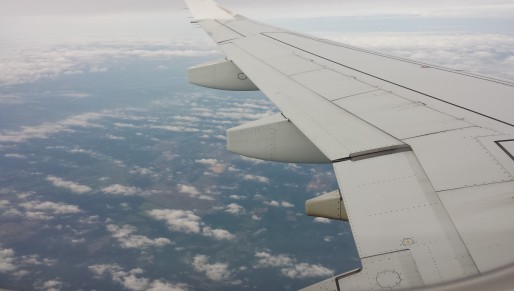
I’ve been travelling a lot lately, which is always its own mixture of fun, frustrating, tedious and exciting. I enjoy getting to see new places and explore new scenery but I’m not sure I will ever miss being bleary-eyed at airports, checking I have my passport for the five thousandth time and hoping I haven’t missed a last-minute gate change.
Unfortunately, airlines have yet to have a row of seats with trestles so the embroidery addicts can bring their frames as they fly, so my Jacobean crewelwork is currently hiding under the tissue paper at home. However, I always make sure I have a few more portable pieces to break up the tiresome waiting that always comes hand in hand with travelling.
Travelling with your craft supplies isn’t always easy. First of all, you can’t bring your entire stash. After all, you do need to leave room in your suitcase for all those exotic new fabrics and yarns you will undoubtedly find on your routes around cities that just happen to cross every craft store in town. The other issue is airport security can be a little challenging when the contents of your hand baggage might come in handy if you need to dispose of someone on the plane…
The trip to London concluded to one of my favourite museums, the Victoria and Albert (V&A) museum. Whenever I’m in London, I always try and visit the V&A and I’ve still only seen a small fraction of the incredible collection they have.
Everything about the V&A is fabulous – the building, the exhibitions, the entire scale of the museum. If you can think of it, they probably have a collection on it. I’ve seen everything from a collection of locks and locking mechanisms, to armour for animals alongside more traditional pieces of art.
As it is a British national museum, entrance is absolutely free. You do have to pay to see the special exhibitions (tickets are around £15 for non-members) they have but that is it. They have an extensive gift shop and cafes if you want to support the work they do, which I would wholeheartedly encourage. There are few museums with collections as extensive and varied as the V&A’s.
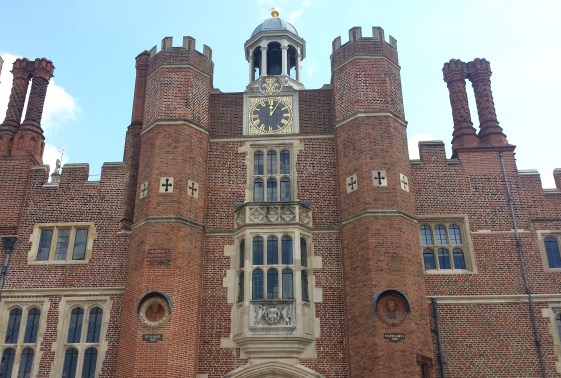
One of the main reasons for visiting London was getting the chance to see the Royal School of Needlework’s current exhibition, ‘Peacocks and Pomegranates’, which was also a good excuse to visit Hampton Court Palace as well.
The RSN has been based in Hampton Court Palace since 1987, having originally opened its first studio in 1872. It’s a fitting location for the organisation that does a significant amount of work for the Royal Family and is responsible for the restoration and conservation of many treasured pieces of textile history.
Hampton Court in the distance
Before you enter the palace though, you might want to take the time to visit Creative Quilting, a lovely little quilting shop just before the bridge to the Palace.
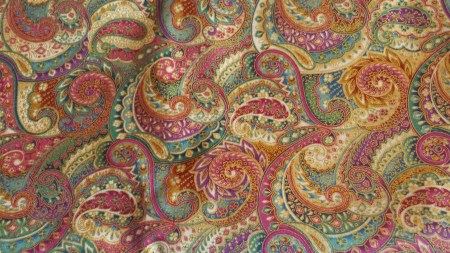
It has a great selection of fabrics, patchworking and quilting books and all the assorted paraphernalia you might need. They are also happy to cut fabric from 10 cm widths, so you can get exactly how much you need. I was relatively restrained with purchasing a few Batiks for a scrappy quilt but I couldn’t help but leave with some of this absolutely fabulous Robert Kaufman fabric. Not sure what I’m going to use it for just yet, but it deserves a special project.
15713 Robert Kaufman Japan
If anyone knows a UK retailer with a good range of Robert Kaufman fabrics, please let me know! Having seen Peggy Toole’s Lumia collections, I do want to get my hands on some.
Hampton Court Palace was one of the palaces belonging to the infamous English king, Henry VIII. Although it was originally intended for Cardinal Thomas Wolsey, Archbishop of York, when he fell afoul of Henry’s fickle affections, gifted it back to the king, perhaps hoping he could avoid his downfall.
This week, I’ve had a few days away in London, mostly to see the Royal School of Needlework’s ‘Peacock and Pomegranates’ exhibition, but also to enjoy some of what the capital has to offer. One of the great things about London is just how much variety there is in things to do and places to go. For crafters in a lot places, the local yarn shop’s best offering is some sad looking balls of Robin’s acrylic double knit but in London, you’re spoilt for choice.
Shopping in general is also a different experience, with a wealth of glitzy stores housing luxury brands. However, learning a little about garment construction and how to sew a decent seam has made me realise that there is a lot of smoke and mirrors to expensive clothing. I will never fail to be amazed how many ‘top end’ brands still have sloppily overlocked seams and raw edges disintegrating by the day.
However, while managing to get completely lost in the bowels of Harrods, there was something that caught my eye…
This tiny section of beading and feathers is part of a beautiful velvet evening jacket by Ralph and Russo, a British haute couture fashion house. Normally haute couture is a little too bonkers for me but Ralph and Russo’s work is exceptional. The extensive hand embroidery on their pieces is an exhibit of the finest appliqué, beading, and metalwork. Sadly far, far beyond my budget but definitely worth a look at for some design inspiration.
Inspiration for new projects and designs can come from anywhere. Postcards often have excellent subjects for small embroidery designs and architecture can make an interesting starting point for thinking about shapes or maybe a piece of blackwork in its own right. However, there is one theme that is common in all forms of art, from thread painting to Romantic poets, and that is the beauty of the natural world. We were going to the right place to see nature at its finest, Kew Gardens, one of England’s most famous botanical gardens.
Day 3 of the Jacobean course came around a lot faster than I had expected. I was a little behind as framing up had taken slightly longer than it should have (tip: when sewing the webbing to the linen twill, it helps to put your stitches through both the linen and the twill.) Today though was all about the stitching.
I had dutifully laid all the ladders along the main trunk of the tree for homework which had taken a surprising amount of time. The main thing is to follow the line of the curve of the design and, in areas where things like the trunk splits in two, keep the design looking matched and continuous.
Today was all about learning as many stitches a possible so I would be able to independently complete various parts of the design. As you tend to stitch back to front, I was quite restricted on what areas I could stitch with the main trunk not being completed. However, we managed to find more than enough to keep us busy.
The main trunk is being worked in raised stem band, which is a really fun stitch to do. After laying the ladders, you then weave the needle over and under each subsequent ladder. It’s a bit easier with a blunt tapestry needle but the fat, fluffy nature of crewel wool means that it’s very easy to accidentally stitch through a ladder rather than around it. The key thing is keeping the tension even in the stitching, enough that the stitches don’t become huge loops but not so much that you distort the bars.
With my design finished after Day 1 and having done some colouring and planning for homework, it was time to start framing up my Jacobean crewelwork piece.
Framing up on an embroidery frame is often a very different beast to ‘just’ popping a piece in a ring frame. However, it is worth doing as ring frames can’t hold that much tension on the fabric and even if you get it ‘drum tight’ to start, after a few hours of stitching you end up yanking the material back through the ring, desperately trying to stop it being a saggy, sad mess.
With slate frames, there are no such issues. They will happily keep tension for years, ideal if the average duration of your embroidery projects is a decade, and you can get very even, tight tensions making it much easier to be precise with the stitching.
A blank canvas
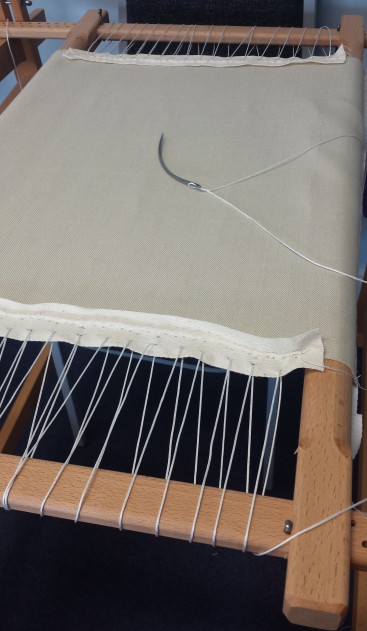
The whole process is quite involved, as you essentially need to add pieces of calico and webbing to your original fabric (linen twill in my case) to allow you to attach it to the frame. This means a lot of hand sewing to attach the additional pieces of fabric and some bloody fingers as well in my case.
The webbing is attached down the sides for lacing into and the calico is attached at the top so you can sew it to the scrap fabric attached to the roller bars on the frame. The roller bars stretch the work vertically and the lacing provides the horizontal stretch. The roller bars so what the name implies, once you’ve stitched the fabric on you roll them around to start applying the tension.
The oversized, vicious looking needle on the middle of the linen there is a bracing needle. There’s a short health and safety talk before you get to use one of these, about keeping the point safely embedded in some cork for storage and making sure to sew down through the fabric so you don’t come up through the fabric and your hand at the same time. They do glide through the heavy webbing though.
Wonderwool, one of the UK’s biggest fibre shows, was last Sunday and it was an absolutely beautiful day for an adventure into Wales.
Royal Welsh Showground
There were over two hundred exhibitors at the show, which was held at the Royal Welsh Showground. The advantage of the location was that, despite the crowds of fibre enthusiasts, there was plenty of space to walk around and you weren’t at risk of getting mown down if you stopped to look at anything.
Today marks the beginning of my Royal School of Needlework Certificate course with some Jacobean Crewelwork!
Jacobean crewelwork is a 17th century surface embroidery technique that typically depicts exotic flora and fauna and some very comic interpretations of what are allegedly animals. While you do see some squirrels, snails or native English wildlife, many of the beasts were stitched from second-hand descriptions or paintings so are what might be generously described as ‘stylised’.
One things I’ve noticed since I’ve started hunting for Jacobean design inspiration is quite how commonplace it is. Even my own curtains turned out to be Jacobean-inspired!
The beginning of the day involved sitting down and pawing through some of these wonderful books, making a note of any particular designs I liked or wanted to incorporate in my own work. A lot of these books come with their own templates which makes tracing and copying much easier, rather than trying to work out the outline of a shape from the photographs.








 astitchornine