Rage-inducing Dyeing

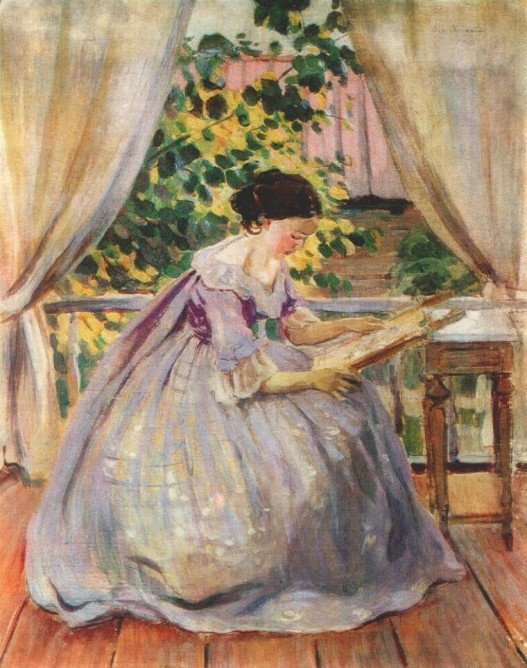
The stereotypical, historical image of the embroiderer is a refined young lady, sat at her frame, serenely rearranging threads to make beautiful artwork. The work is delicate, yet meticulously done, with no lapses in patience or temperament, all whilst wearing her Sunday best.
1
‘Lady Embroidering’ by Victor Borisov-Musatov

The reality of the crafter is distinctly less dignified. Dye up the kitchen walls, fridge and floor, needles in fingers and blood pooling on your whitework. Swearing. Frayed threads, wonky cutting and holes in places they were supposed to go. More swearing. Half-done projects abandoned to the back of cupboard, claims of never making a stitch again and of course, lots more swearing.

I think the myth of making things always being fun and relaxing is actually one of the things beginners can find off-putting. Unless you know how many hours of practice and learning it really takes to produce a fantastic piece, it can be really disheartening to have spent hours struggling with seams only to find you haven’t caught the raw edges properly or inconsistencies in your tension when knitting have resulted in a scarf that best resembles jelly.

For the most part, I really do love creating new projects. Daydreaming about colours, calculating up seam allowances, finally getting stuck in with the stitching. However, there are some projects that just seem to go wrong at every corner and the only joys in finishing the thing so you don’t have to look at it again.

Read More »

Wonderwool 2016

Wonderwool, one of the UK’s biggest fibre shows, was last Sunday and it was an absolutely beautiful day for an adventure into Wales.

4.jpg
Royal Welsh Showground

There were over two hundred exhibitors at the show, which was held at the Royal Welsh Showground. The advantage of the location was that, despite the crowds of fibre enthusiasts, there was plenty of space to walk around and you weren’t at risk of getting mown down if you stopped to look at anything.

Read More »

Silk Drying

3

My handpainted silks are finally dry! As you can see from comparison to the photos from the other post, some of the colours, particularly ones I’ve mixed myself, aren’t as intense as they were when the silk was still wet. However, some sections, particularly the red and green/yellow silks have come out with exactly the kind of colour saturation and intensity I was looking for. Lots of dye and aggressive mashing of the fibres seems to be the trick with handpainting. Thinning down the top beforehand did help but made it more difficult to handle, so I’m not sure it was worth it on reflection.

In general, I didn’t lose too much dye in the rising process but the turquoise sections took significantly more rinsing than any other colour. It’s remained a nice, saturated colour but I’m not sure if there’s something about that particular dye that meant it didn’t fix as well or maybe needed more vinegar in those areas.

12

Read More »

Yarn painting and silk

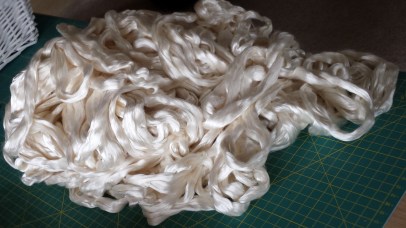
This Christmas, I treated myself to a rather sizeable delivery from World of Wool, including over half a kilo of lovely, mulberry silk. Unfortunately, I’ve not had much time to do much other than admire the packet but this weekend I fancied doing something a little less regimented than needlework and thought I’d have a go at some yarn painting.

silk_pile
No such thing as too much silk!

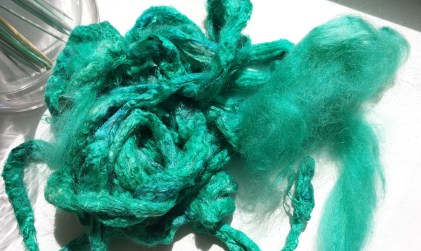
One issue I’ve had with some of the yarn painting I’ve done is that the colours don’t always look as saturated or intense when the yarn is dry as they do during the dyeing process. I dyed the silk below using mostly greens with some black and mid-blues mixed in as well. Apparently adding a few drops of black can help the colours look more intense.

dyed_top.jpg
Dyed silk top

Read More »